
Who does what, how equipment is certified, how results are audited, and what the public record shows, including the executive orders and court rulings of 2025–2026.
U.S. elections are run under a layered system: federal law sets minimum standards, states write the rules, and counties or townships print ballots, count votes, and certify results. Here we cover the formal mechanics – equipment certification, pre-election testing, and post-election auditing – set out the documented findings from two 2020–2021 events widely discussed online, and close with the executive orders and court rulings of 2025–2026 that tested the system’s constitutional limits.
AT A GLANCE
Constitutional authority: Article I, §4 gives states primary authority over elections; Congress may override; the president has no role in this scheme
Federal baseline: Help America Vote Act of 2002 (HAVA), which created the U.S. Election Assistance Commission (EAC)
Equipment standard: Voluntary Voting System Guidelines (VVSG) 2.0, adopted Feb. 10, 2021; first system certified: Hart InterCivic Verity Vanguard 1.0 (2025)
Accredited test labs: Two EAC-accredited Voting System Test Laboratories — Pro V&V and SLI Compliance
Pre-election check: Logic-and-accuracy (L&A) testing of every voting machine before each election
Post-election audits: 34 states require traditional audits; five require risk-limiting audits (RLAs); 98%+ of jurisdictions use paper-based systems
2025 development: Executive Order 14248 (Mar. 25, 2025) challenged the EAC’s independence; three federal courts issued permanent injunctions blocking key provisions
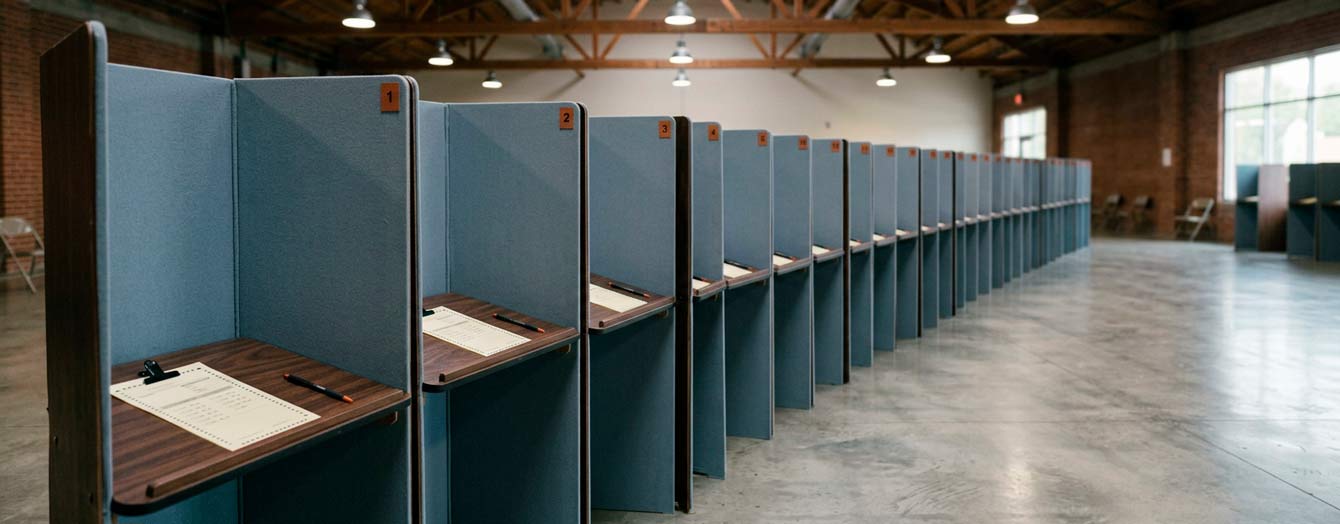
Federal, state, and county roles
Under the U.S. Constitution, states set the time, place, and manner of elections, subject to congressional override. Federal law establishes minimum standards: the Voting Rights Act (1965), the National Voter Registration Act (1993), the Help America Vote Act (2002), and the Uniformed and Overseas Citizens Absentee Voting Act (1986). Within those limits, each state writes its own election code, and the chief election officer (usually the Secretary of State) supervises implementation.
Actual administration happens at the local level: county elections offices, town clerks, or local boards of elections maintain voter rolls, acquire and operate voting equipment, staff polling places, count ballots, and certify results to the state.
How voting equipment is certified
The U.S. Election Assistance Commission is an independent, bipartisan federal agency created by HAVA. It publishes the Voluntary Voting System Guidelines (VVSG) – specifications that voting systems are tested against for functional capability, accessibility, and security. The current standard, VVSG 2.0, was adopted on February 10, 2021; as of November 16, 2023, new certifications must be tested against it. In 2025, the EAC announced that Hart InterCivic’s Verity Vanguard 1.0 had become the first system to complete VVSG 2.0 certification.
Only two laboratories are currently accredited by the EAC to perform this testing: Pro V&V and SLI Compliance. Testing covers source code, hardware, and documentation; the full cycle typically takes months. Thirty-eight states and the District of Columbia incorporate EAC certification into their own requirements; the remainder run state-only programmes. Systems previously certified under VVSG 1.0 or 1.1 remain lawful for use – the EAC does not decertify older systems when the standard changes.
Logic-and-accuracy testing before every election
Before each election, local officials run logic-and-accuracy (L&A) testing on every machine that will be deployed. L&A testing runs a known set of test ballots through each scanner and tabulator and confirms that the reported result matches the ballots fed in. It also verifies that only the certified version of the software is installed. L&A procedures are set by state law; most jurisdictions conduct the tests publicly and invite party observers.
Post-election audits – traditional vs. risk-limiting
After polls close, most states audit their reported results. There are two broad families:
- Traditional audits. A fixed share of ballots or precincts is hand-counted and compared to the machine count. California historically required a 1% manual tally. The method is simple, but it does not adapt to how close the race was, and it provides no statistical guarantee that the reported winner is correct.
- Risk-limiting audits (RLAs). A statistically designed procedure that keeps sampling paper ballots until there is strong evidence the reported winner actually won, escalating to a full hand count if that evidence does not appear. Colorado became the first state to run statewide RLAs in 2017; Rhode Island followed in 2020. Per MIT Election Lab, 34 states require traditional audits and five require RLAs.
RLAs come in three methods: ballot-comparison matches each sampled ballot against its cast-vote record; batch-comparison hand-counts randomly selected batches; ballot-polling samples individual ballots without relying on cast-vote records. The sample size depends on the margin: a landslide needs few ballots; a tight race may require a full hand count.
The EAC has formally affirmed that over 98% of U.S. jurisdictions already use voting systems that produce a paper record of every vote cast.

2025–2026: Executive orders, court rulings, and equipment standards
The formal mechanics of election administration described above do not change year to year. What changed significantly in 2025–2026 was an attempt at federal executive intervention, and the constitutional limits that the courts found that intervention crossed.
Executive Order 14248 – March 25, 2025
President Trump signed EO 14248, “Preserving and Protecting the Integrity of American Elections.” Among its directives, the order instructed the EAC to: (1) require documentary proof of citizenship on the national voter registration form within 30 days; (2) revise voting-system certification guidelines and rescind all existing machine certifications within 180 days; and (3) grant the Department of Homeland Security and other federal agencies access to state voter registration databases. A second executive order in March 2026 sought to require the U.S. Postal Service to restrict mail-ballot delivery based on federally managed approved-voter lists.
Court response
Because the Constitution’s Elections Clause assigns authority over federal elections to states and Congress, not the president, EO 14248 prompted immediate legal challenges from 21 states, voting-rights organisations, and the Democratic Party. The courts ruled as follows:
- April 24, 2025. U.S. District Court for the District of Columbia issued a preliminary injunction blocking the EAC citizenship-proof directive (LULAC v. Executive Office of the President).
- October 31, 2025. Judge Colleen Kollar-Kotelly issued a permanent injunction holding that the president has no constitutional authority to dictate the contents of the national voter registration form.
- January 9, 2026. Judge John Chun (W.D. Washington) issued a permanent injunction blocking multiple provisions, including the mail-ballot Election Day receipt deadline (applicable to Washington and Oregon) and the elimination of guidance on QR-code tabulation (State of Washington v. Trump).
- January 30, 2026. Judge Kollar-Kotelly issued a second permanent injunction blocking Section 3(d), which sought to require documentary proof of citizenship on the Federal Post Card Application used by military and overseas voters under UOCAVA.
The EAC itself did not implement the order’s directives during this period. Its Technical Guidelines Development Committee convened discussions on revised machine standards but had not reached consensus on a new draft as of early 2026.
SAVE Act
H.R. 22, the Safeguard American Voter Eligibility Act, would amend the National Voter Registration Act to require documentary proof of citizenship for registration in federal elections. The House passed it on April 10, 2025; the companion Senate bill (S. 128) had not been enacted as of April 2026.
Maricopa County’s 2020–2021 review
Maricopa County, Arizona, cast approximately 2.1 million ballots in the November 2020 general election. The certified canvass, transmitted to the Arizona Secretary of State on November 23, 2020, reported Joe Biden carrying Arizona by 10,457 votes statewide. Between November 2020 and early 2021, the county conducted the audits required by Arizona law: statutory hand-count samples, post-election L&A tests, and two independent forensic audits of its tabulation equipment by Pro V&V and SLI Compliance. All confirmed the reported results.
The Arizona Senate review
In December 2020, the Arizona State Senate issued subpoenas and took custody of the county’s 2.1 million ballots and 394 pieces of tabulation equipment. The Senate hired Cyber Ninjas — a Florida-based cybersecurity firm with no prior election-audit experience and no EAC accreditation. Materials were delivered to the Arizona Veterans Memorial Coliseum in April 2021. Cyber Ninjas’ final report, delivered on September 24, 2021, confirmed the certified canvass: its hand count produced totals within hundreds of votes of the official count, with revised figures showing 99 additional votes for Biden and 261 fewer for Trump.
The county’s rebuttal
On January 5, 2022, Maricopa County published a 93-page report titled Correcting the Record. Of 77 claims in the Cyber Ninjas materials, the county classified 38 as inaccurate, 25 as misleading, and 11 as false. The county confirmed one real error: 50 ballots had been double-scanned by a temporary staffer. The double-count did not change the outcome of any race.
The equipment replacement
Arizona Secretary of State Katie Hobbs informed the county that chain of custody on the subpoenaed equipment had been broken when uncertified contractors took possession of it. Under EAC rules, such equipment cannot be returned to service. In July 2021, the county voted to replace the machines. The Dominion Voting Systems contract was amended from $6.1 million to $9 million to cover 385 replacement tabulators and nine central counters, an incremental cost of roughly $2.8 million. The replacement followed chain-of-custody rules, not a judgment about the accuracy of the 2020 count.
Case: the 2021 California gubernatorial recall
California’s 1911 constitutional recall provision allows voters to petition for the removal of a sitting state official. After petitioners submitted roughly 1.72 million valid signatures, Lt. Governor Eleni Kounalakis called the election on July 1, 2021, for September 14, 2021. All active registered voters received a mail ballot; 46 candidates appeared on the replacement question.
The certified results
The California Secretary of State certified the results on October 22, 2021. Of approximately 12.8 million ballots counted:
- “No” on recall: 7,944,092 votes – 61.9%
- “Yes” on recall: 4,894,473 votes – 38.1%
- On the replacement question, Larry Elder received approximately 48.5% of votes cast, the highest total among 46 candidates. Roughly 42.7% of voters declined to answer the second question.
Elder conceded on the night of September 14, 2021. No court set aside the certified result, and no election contest was filed. Governor Newsom retained office with 61.9% voting “no” on recall, almost identical to his 61.9% winning margin in the 2018 general election.
Separately, more than 60 lawsuits were filed nationwide challenging the 2020 presidential election results, including several in Arizona. The great majority were dismissed on the merits, for lack of standing, or withdrawn. Judges appointed by presidents of both parties ruled against the claims. One partial success in Pennsylvania concerned the deadline for curing missing ID on mail ballots and did not affect the overall state result.
Questions people ask
At the federal level, the U.S. Election Assistance Commission, via two accredited laboratories (Pro V&V and SLI Compliance), tests systems against VVSG 2.0. States then run their own certification on top of that. Before each election, local officials run L&A testing on every machine. Hart InterCivic’s Verity Vanguard 1.0 was the first system to receive VVSG 2.0 certification, announced in 2025.
A statistical procedure that hand-checks enough randomly selected paper ballots to give a specified minimum confidence, typically 90–95%, that the reported winner of a contest actually won.
No. The review’s own hand count confirmed the certified results and reported that Biden had a slightly larger margin than the official canvass. The county’s January 2022 rebuttal classified 74 of the 77 audit claims as inaccurate, misleading, or false, and confirmed one real error that changed no race.
The Arizona Secretary of State determined that chain of custody on subpoenaed equipment had been broken when uncertified contractors took possession of it. Under EAC chain-of-custody rules, equipment in that condition cannot be returned to service. The replacement cost the county roughly $2.8 million.
Three federal courts issued permanent injunctions blocking its core provisions. The court in Washington, D.C. held that the president has no constitutional authority to direct the contents of the federal voter registration form. The EAC did not implement the order’s directives. The machine-certification directive remained in active litigation as of April 2026.
eac.gov · VVSG 2.0 · Maricopa “Correcting the Record” · California SoS elections · Congress.gov – EO 14248 legal background
A NOTE ON SOURCING
Every figure on this page is drawn from official government sources: the U.S. Election Assistance Commission, Maricopa County’s published rebuttal, the California Secretary of State’s certified canvass, court opinions, and the Library of Congress Congressional Research Service. The 2025–2026 court rulings are cited from published federal district court opinions. Characterisations of the Cyber Ninjas report reflect the county’s published classification of each claim. No certified election result is described here as rigged or stolen, because no court has so found.
This page is informational only. For questions about voter registration, ballot rules, or filing an election contest in a specific state, consult that state’s Secretary of State or a qualified election-law practitioner.